In the first half of 2026, China's automobile exports continued their strong growth momentum, with key indicators reaching new highs and drawing widespread attention both at home and abroad.
According to data from the China Association of Automobile Manufacturers (CAAM), the General Administration of Customs, and relevant consulting agencies, from January to May 2026, China's automobile export volume increased by over 45% year-on-year in general, and exceeded 60% under certain statistical calibers. Exports in the first half of the year are expected to approach 5 million units, and the annual export volume is likely to surpass the 10-million-unit mark for the first time. Behind this trend lies the systematic reflection of multiple transformations, including product structure optimization, market territory expansion, trade mode upgrading, and industrial layout adjustments.
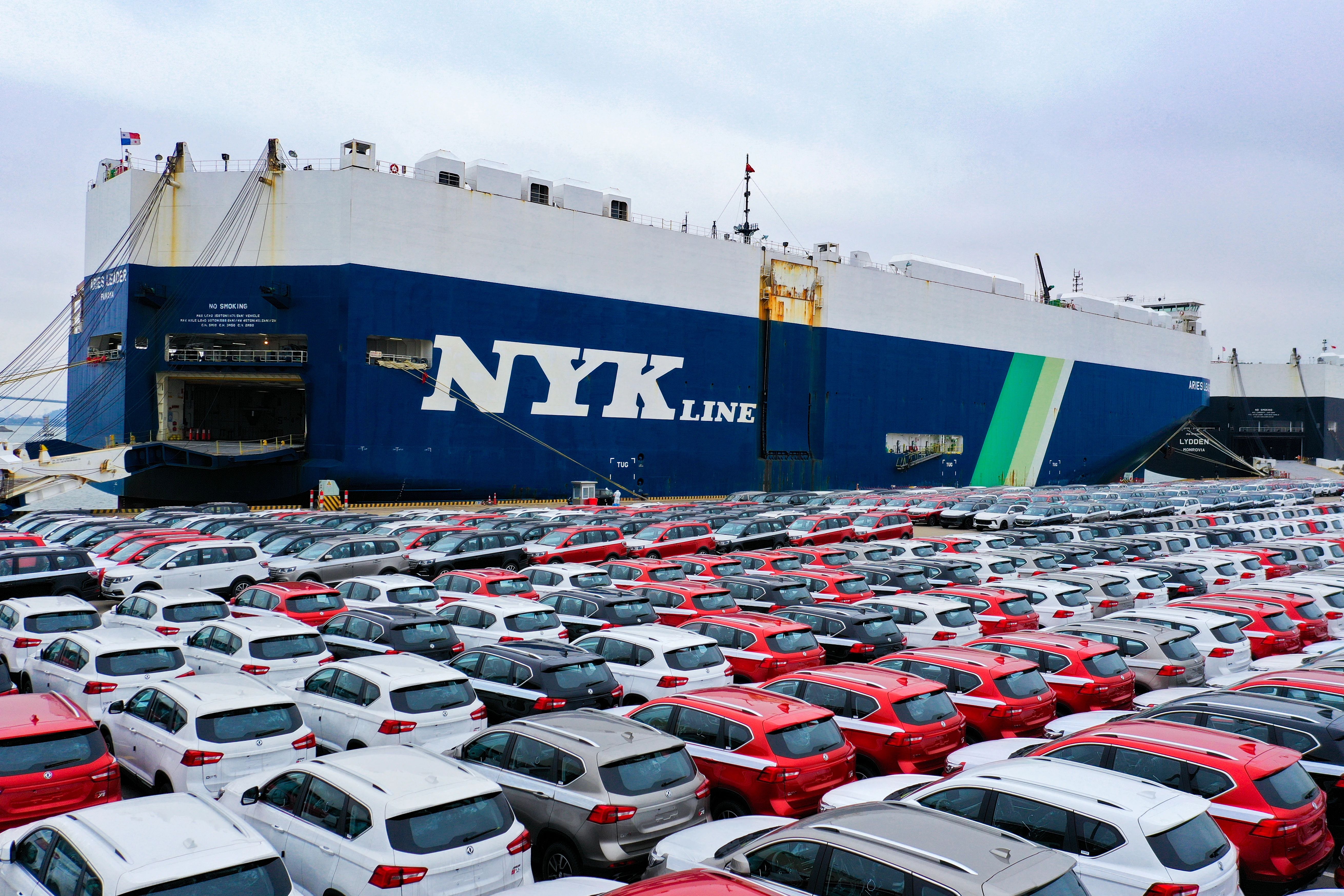
01 New Energy Vehicles Show High Growth Momentum
Data from CAAM shows that in the first five months of 2026, China exported 4.059 million vehicles, a year-on-year increase of 63%. Among them, exports of new energy vehicles (NEVs) reached 1.833 million units, a surge of approximately 110% year-on-year, accounting for over 45% of total vehicle exports. In May, this proportion approached 50%, making NEVs the core driving force behind export growth.
This structural change is based on enhanced product competitiveness. Stephen Dyer, Head of the Asia Automotive Practice at AlixPartners, pointed out that Chinese automobiles possess two major comparative advantages: cost control and smart technologies. The European market has a supply gap for vehicles that are moderately priced and equipped with rich smart features, and Chinese products effectively fill this market space with their higher adoption rate of advanced driver-assistance systems and faster iteration speed. The cost advantage stems from high vertical integration and large-scale production capacity, while technology premiums are beginning to emerge in some markets. Features such as 800V high-voltage platforms, integrated die-casting, and self-developed batteries can command a premium of about 10% over comparable models in Europe.
02 Shifts in International Market Layout
Profound changes have taken place in the market landscape. According to statistics by Cui Dongshu, Secretary-General of the China Passenger Car Association (CPCA), the top ten destinations for China's complete vehicle exports from January to May 2026 were: Brazil, Russia, the United Kingdom, Australia, Mexico, Belgium, Italy, the United Arab Emirates, Algeria, and Thailand. The top ten destinations for NEV exports were slightly different: Brazil ranked first with nearly 290,000 units, followed by Belgium and the United Kingdom, with Italy, Germany, and Spain also among the top ten. European countries occupied five spots, while South America and Southeast Asia became important sources of incremental growth.
The Latin American market saw remarkable expansion. Brazil ranking first in both total vehicle exports and NEV exports reflects the rapid increase in penetration of Chinese automobiles in the Southern Hemisphere market. According to statistics, Chinese NEVs have already captured a 79% market share in the Southern Hemisphere.
The strategic value of the European market has become more prominent. Although the EU has imposed additional tariffs of up to 45.3% on battery electric vehicles (BEVs) since autumn 2024, Chinese automakers have largely maintained their export momentum by increasing the rollout of plug-in hybrid electric vehicles (PHEVs) and other means. AlixPartners predicts that sales of Chinese automakers in the European market will grow by 25% to 2.3 million units in 2026, with a market share of about 10%, potentially rising to 16% by 2030. End-consumer data also confirms this trend. According to the European Automobile Manufacturers' Association (ACEA), in May 2026, new car registrations of five Chinese automakers in 31 European countries reached 138,400 units, a year-on-year increase of 64.6%, surpassing for the first time the combined total of six Japanese automakers, including Toyota and Nissan. During the same period, sales of Japanese automakers fell by 3.1% year-on-year, and the market share of internal combustion engine vehicles in Europe narrowed from 38% to 30.1%, with their slow electrification transition significantly constraining market performance.
03 Evolution of Localized Production Capacity Layout
China's automobile going-global strategy is shifting from primarily product exports to localized production and systematic operations. Stephen Dyer believes that product export is only the initial stage of globalization strategy. Chinese automakers are seeking production capacity cooperation worldwide, establishing manufacturing bases overseas to accelerate their transformation into true global enterprises. The AlixPartners report points out that there is approximately 2.5 million units of idle annual capacity in European auto plants, providing potential space for this transformation.
The pace of localized production is accelerating: Chery's joint venture plant in Spain has started production on the M1 line, and a memorandum has been signed for a contract manufacturing project in Sunderland, UK; SAIC's plan for a plant in Galicia, Spain, has materialized; BYD's factory in Hungary, with an investment of 4 billion euros, is expected to start vehicle assembly in the fourth quarter of 2026; Leapmotor, leveraging the Stellantis system, has introduced models for production at the Zaragoza plant in Spain. The practice of Guangzhou is also representative. From January to May 2026, Guangzhou exported over 120,000 vehicles, with the export value increasing by 56.1% year-on-year. GAC Group has already established six overseas plants and over 700 global sales outlets; XPeng Motors has built sales and service networks in 60 countries and regions, while simultaneously advancing localized production in Indonesia, Austria, and Malaysia. From trade exports to capacity going abroad, the internationalization of Chinese automakers is entering a stage of deep operation with the principle of "local for local."
04 Multiple Risks and Challenges
While the export scale is rapidly expanding, some deeper issues deserve attention. First, corporate profitability is diverging. Automakers with high vertical integration, such as BYD, can maintain relatively stable profit levels by relying on self-developed core components. In contrast, a considerable number of small and medium-sized assembly companies depend on outsourced battery, motor, and electronic control systems. Coupled with shipping costs, channel concessions, and tariff expenditures, they face the dilemma of growing orders but meager profits. Second, the impact of trade barriers is continuously deepening. In addition to the EU's countervailing duties on battery electric vehicles, non-tariff barriers such as the Carbon Border Adjustment Mechanism (CBAM), technical access restrictions, and data security regulations are forming new constraints. The overseas expansion model of Chinese automakers is accelerating its shift from trade-driven to localized production, but building factories abroad faces multiple difficulties, including incomplete parts supply systems, high costs for local certifications, and a shortage of compound talents. Third, brand premium capability remains insufficient. At present, the core advantage of Chinese automobile exports still centers on cost, making breakthroughs in the high-end market above 400,000 yuan difficult. Some overseas consumers' perception of Chinese brands remains at the level of "affordable substitutes." The domestic common practice of parameter-based marketing lacks a brand narrative that resonates with local cultures, constraining the enhancement of product added value and brand value.
05 Sustainability Considerations
China's automobile exports have undergone a rapid leapfrogging process: from less than 1 million units in 2020, to 3.11 million in 2022, 4.9 million in 2023, over 5.8 million in 2024, and reaching 7.098 million in 2025, ranking first in the world for three consecutive years. In 2026, the industry generally expects exports to exceed 10 million units, with optimistic forecasts pointing to 12 million. If this expectation is realized, it will set a new historical high for a single country's automobile export volume.
In the next stage, the challenge facing China's automobile industry is no longer simply "how many to export," but more importantly, "in what manner to achieve sustainable global development." Shifting from a sole pursuit of export volume to coordinating market share, brand value, localized operations, and full-industry-chain collaboration, the globalization process of Chinese automotive enterprises is entering a new period of trial.